High-flux electrochemical interfaces
I connect atomistic computation to industrial-relevant devices — machine-learning catalyst design, synthesis, operando mechanism, and membrane-electrode-assembly validation, run as one closed loop.
One workflow, prediction to device
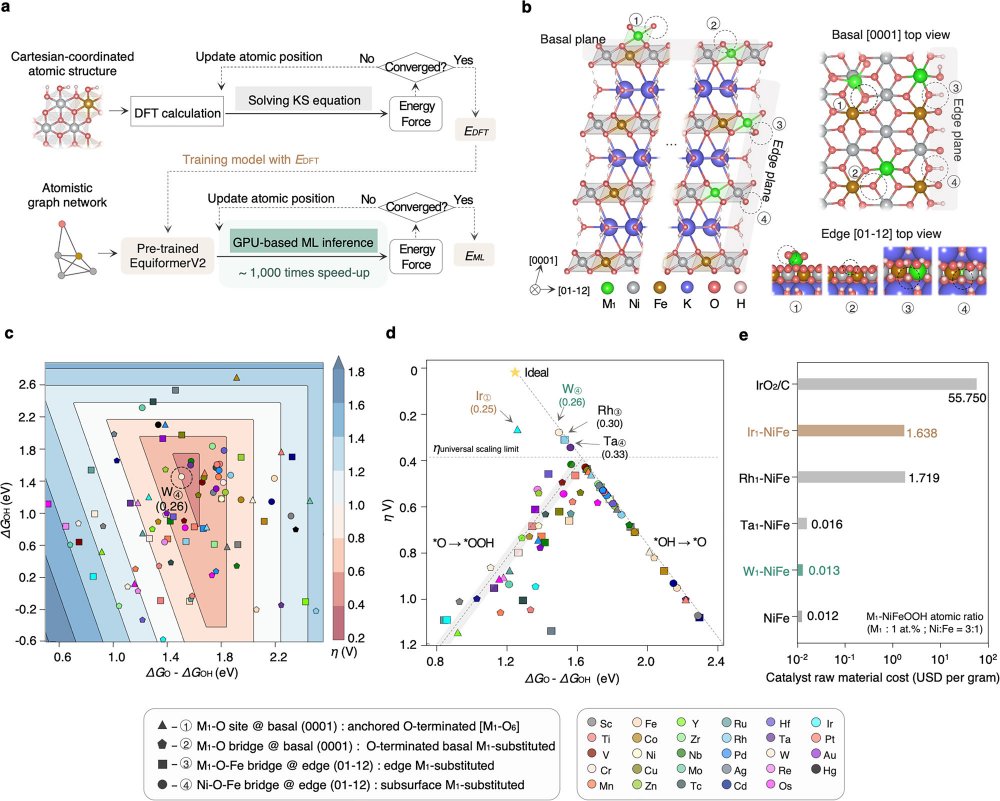
Machine-learned potentials and DFT rank thousands of candidates; the winners are electrodeposited, watched under operando synchrotron and Raman, and validated in zero-gap membrane-electrode assemblies — atoms to industrial current density, one loop.
ML-guided tungsten single atoms for noble-metal-free water electrolysis
The clearest example of how I work: I fine-tuned EquiformerV2 on custom DFT data, screened the full configuration space, identified W₁-NiFeOOH, synthesized it by scalable cyclic electrodeposition, resolved its mechanism with operando spectroscopy, and validated it in an AEM electrolyzer — prediction, mechanism, and device connected in one loop.
The same theory-to-device approach carries across CO₂ electroreduction, glycerol and oxygenated-feed upgrading, acidic enol electrooxidation, and electrocatalytic ammonia oxidation. In my current postdoctoral work I am developing a multiscale computational framework — coupling DFT, machine-learned interatomic potentials, and molecular dynamics with explicit solvent — to model ion transport within anion-exchange membranes and ionomer layers, validated through MEA fabrication and testing.